Table of Contents
- What Makes a Solar Charger Suitable for Backpacking
- Best Portable Solar Chargers for Hiking: Product Comparison
- Solar Charger vs Power Bank for Hiking: Which Wins
- Backpacking Solar Charger Wattage: What Output You Actually Need
- Portable Solar Panel Charging Time in Real Conditions
- Weight, Durability, and Long-Term Reliability
- Safe Charging and Battery Care in the Backcountry
- Frequently Asked Questions
Last Updated: October 12, 2026
What Makes a Solar Charger Suitable for Backpacking
Compact solar chargers for backpacking must balance three demands: meaningful power output, weight light enough to actually carry, and durability against weather and rough handling. The best compact solar chargers for backpacking deliver all three without compromise.
Portable solar panels are folding units that convert sunlight directly into USB power. Unlike a power bank, which stores energy, a solar charger only works when the sun hits it, both its strength and its limitation. In real conditions, this matters far more than the wattage rating suggests.
Most backpackers underestimate device drain on a multi-day trip. A smartphone loses 10-15% battery per day of moderate use (GPS, photos, emergency communication); a GPS unit drains faster, a headlamp slower.
At CampNation, we’ve helped outdoor enthusiasts find the right portable power solution. The difference between a charger that works and one that sits unused comes down to realistic expectations about field conditions, not marketing specs.
Best Portable Solar Chargers for Hiking: Product Comparison
Dozens of options exist, but a handful stand out for serious backpacking. We focused on units that balance genuine utility against the weight penalty. What matters: does it charge your phone faster than the sun sets, and can you afford to carry it for a week?
BigBlue 28W USB Solar Charger
The BigBlue 28W is the strongest contender for backpackers willing to carry extra weight for faster charging. At 1 pound 5 ounces it’s heavier than most competitors, but the 28-watt output earns that weight: in direct sunlight, a smartphone goes from empty to 50% in roughly 90 minutes, useful on a long day hike when you need navigation before nightfall.
What works: It folds to roughly paperback size, fitting a backpack’s side pocket. Multiple USB ports charge two devices at once, and users report years of reliable performance in wet conditions.
What doesn’t: The weight adds up on longer trips, and it needs direct sunlight, performance drops sharply in overcast or shaded conditions. In dense forest or cloudy weather, expect charging times to double or triple.
Best for: Hikers on 2-4 day trips who prioritise charging speed over pack weight, or anyone regularly hiking in open terrain with reliable sun exposure.
Goal Zero Nomad 10
The Goal Zero Nomad 10 takes the opposite approach: lightweight simplicity. At 6.3 ounces, it’s one of the lightest panels on the market, and its 10-watt output is honest. You won’t charge a dead phone in 90 minutes, but you can trickle-charge 20-30% over 4-5 hours of decent sunlight.
What works: The weight is negligible, you’ll forget it’s in your pack. Goal Zero’s field reliability is well-earned, and the compact fold saves space.
What doesn’t: Low wattage means betting on patience. If you need a charged phone by evening, this alone won’t guarantee it, and the single USB port charges one device at a time.
Best for: Ultra-lightweight backpackers on trips under 5 days, or anyone pairing a solar panel with a power bank to cover gaps.
SunnyBag SUNBOOSTER 21
The SunnyBag SUNBOOSTER 21 sits in the middle: 21 watts in a package lighter than the BigBlue, more power than the Nomad 10, less weight than the 28W. Reinforced stitching and weatherproof materials suit real backcountry use.
What works: The power-to-weight balance is genuinely useful, in good sun, a phone reaches 60-70% in 2-3 hours. SunnyBag designs for outdoor enthusiasts, and dual USB outputs add flexibility.
What doesn’t: Detailed specs are harder to find, making performance claims harder to verify independently. Like all solar chargers, it depends entirely on sun exposure, shade or overcast significantly reduces effectiveness.
Best for: Backpackers on 4-7 day trips who want genuine charging capability without the weight penalty of the 28W panels.
| Product | Weight | Output | Best For | Key Trade-off |
|---|---|---|---|---|
| BigBlue 28W | 1 lb 5 oz | 28W | Speed-focused hikers | Heavy for ultralight trips |
| Goal Zero Nomad 10 | 6.3 oz | 10W | Ultralight backpackers | Slow charging, single port |
| SunnyBag SUNBOOSTER 21 | ~12 oz (est.) | 21W | Multi-day trips | Mid-range specs, less documentation |
Solar Charger vs Power Bank for Hiking: Which Wins
Should you carry a solar panel or a power bank, or both?
A power bank is a rechargeable battery: charge it at home, carry it, and it’s instantly ready when your phone dies. A solar charger only works when the sun shines and you’re positioned to catch it.
But the trade-off is weight and planning. A 20,000mAh power bank (two full smartphone charges) weighs 6-8 ounces; a solar charger delivering the same total energy weighs less but needs sun, time, and positioning. Here’s how the decision breaks down:
Choose a power bank if: Your trip is 3 days or fewer, you’re in forest or overcast terrain, or you’re unwilling to sacrifice charging speed for weight savings. Power banks are the reliable choice for most weekend campers.
Choose a solar charger if: Your trip is 5+ days, you’re in open terrain with consistent sun, or you’re already carrying a small power bank and want a backup that doesn’t add much weight.
Choose both if: You’re doing a week-long backcountry trip and can afford the combined weight. The power bank covers you on cloudy days; the solar charger tops it up on sunny ones. This is the setup serious backcountry users actually carry.
Solar’s hidden advantage is psychological: on a long trip, knowing you can generate power reduces battery anxiety. That peace of mind is worth something, even if the math doesn’t perfectly justify the weight.
Most backpackers should start with a power bank. Add a solar charger only if your trips consistently exceed 5 days or you regularly hike in open, sunny terrain.
Backpacking Solar Charger Wattage: What Output You Actually Need
Solar charger wattage is where marketing and reality diverge most sharply. A 28-watt panel doesn’t deliver 28 watts to your phone, the real number is much lower, and understanding why matters.
A smartphone USB port accepts 5 volts at up to 2-3 amps, a maximum of 10-15 watts. A 28-watt panel is rated at peak output under ideal conditions: direct sun, 90-degree angle, perfect temperature. In the field you lose power at every step: imperfect angles, clouds cutting output 50-80%, dust and heat reducing efficiency.
That’s still useful, it’s faster than many phone chargers, but it’s not the theoretical maximum. A 10-watt panel, similarly, delivers 5-8 watts in real conditions.
For backpacking, here’s what you actually need:
- Under 3 days: 5-10 watts is fine. You’re mostly topping up during rest breaks.
- 3-5 days: 15-20 watts gives you meaningful charging without excessive weight.
- 5+ days: 20-28 watts justifies the weight if you’re in open terrain with reliable sun.
Wattage matters less than trip length, terrain, and phone reliance. A GPS unit with a built-in battery lasts longer than a smartphone, so you may need less capacity; a photographer using a phone constantly might need more.
Don’t chase wattage numbers. Instead, estimate how many hours of direct sunlight your trip will have and how much battery capacity you need to cover the gaps. Then pick the charger that balances that requirement with acceptable weight.
Portable Solar Panel Charging Time in Real Conditions
The specs say the BigBlue 28W charges a phone in 90 minutes. That’s marketing math, not field reality.
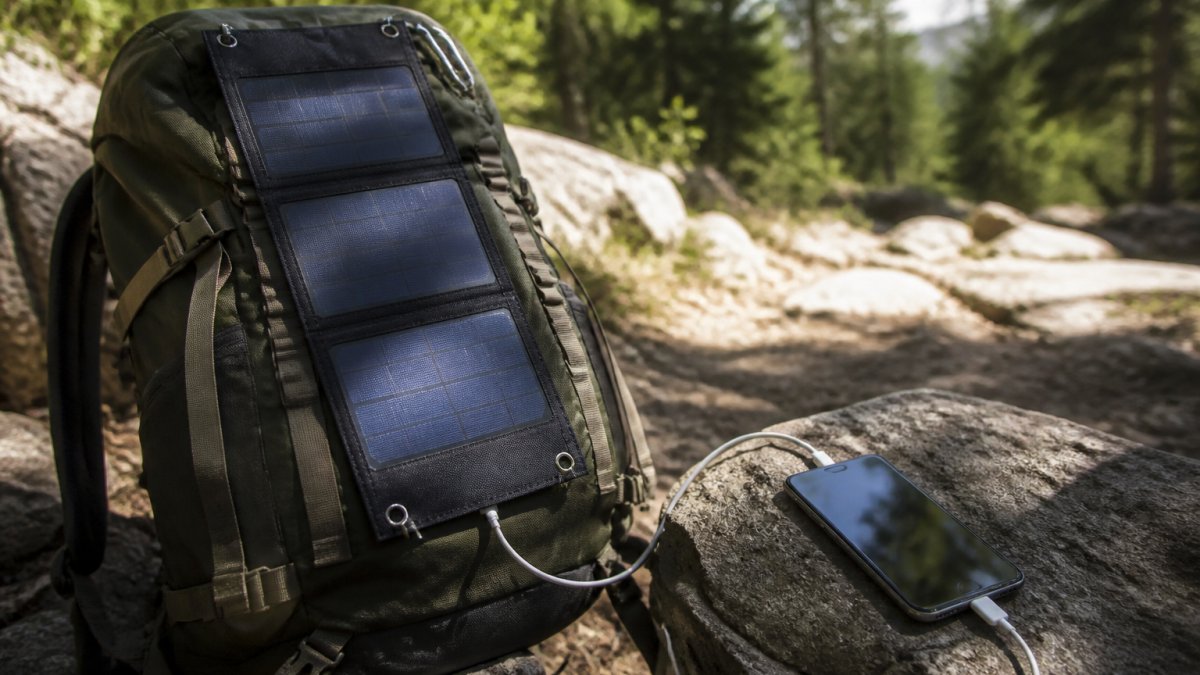
In genuine direct sunlight with the panel angled properly, you might see that speed. But direct sunlight is rare on a backpacking trip: you’re hiking, not sitting with your phone tethered to a panel.
In realistic field conditions:
- Clear sky, good angle: 60-90 minutes for 50% charge (BigBlue 28W)
- Partly cloudy, imperfect angle: 2-3 hours for 50% charge
- Overcast, shaded: 4-6 hours for 50% charge (if it charges at all)
- Dense forest: Don’t bother. The panel won’t generate enough power to overcome the phone’s drain rate.
The Goal Zero Nomad 10 cuts those numbers roughly in half for the same conditions. Expect 2-3 hours for 30% charge in good sun.
This is why experienced backpackers don’t rely on solar alone. It works best as a maintenance tool: charge during lunch, top up during rest breaks, and let the sun work while you hike.
Weather matters more than wattage: a 28-watt panel in overcast conditions charges slower than a 10-watt panel in direct sun. If the forecast shows rain or cloud cover, reconsider whether solar makes sense at all.
Weight, Durability, and Long-Term Reliability
A solar charger you don’t carry is useless. Weight matters enough to determine whether you’ll actually use it.
The BigBlue 28W at 1 pound 5 ounces is heavier than most backpackers want unless the trip exceeds 5 days, roughly the weight of a full water bottle. On a 20-litre pack it’s noticeable; on a 40-litre pack, less so.
The Goal Zero Nomad 10 at 6.3 ounces is genuinely light. You’ll notice it less than a spare pair of socks. That lightness makes it more likely to actually get carried, which matters more than raw charging capacity.
Durability is where solar chargers earn their premium price. CampNation provides high-quality gear, from essential hiking tools to smart add-ons, all built to last and perform reliably in real outdoor conditions, making your trail journeys smoother and your camping experience better.
Goal Zero’s reputation is well-earned. Their panels survive years of field use. BigBlue is solid but less well-known in the backcountry community.
The real durability test: can you repair it in the field? Most solar panels can’t be. A torn USB cable is a permanent failure unless you carry a spare, and a cracked cell is irreparable.
Safe Charging and Battery Care in the Backcountry
Solar chargers are safe, but a few precautions prevent damage to your devices and the charger itself.
Never leave a phone charging unattended in direct sun.
Protect the panel from moisture when not in use.
Keep the USB ports clean. Sand and dirt can corrode the connector pins, making charging unreliable. A small brush or cloth takes seconds and prevents frustration later.
Avoid charging in extreme heat: if your phone is warm from hiking, let it cool first, since charging a hot device accelerates degradation.
For multi-day trips, adopt a charging routine: charge during lunch when you’re resting anyway, then disconnect before you resume hiking. This balances charging needs with device protection.
Choosing the right compact solar charger for backpacking comes down to honest answers about your trip length, terrain, and how much weight you’re willing to carry.
Frequently Asked Questions
Are compact solar chargers worth taking backpacking?
Yes, if your trip lasts more than three days or you’re travelling off-grid without resupply points. A compact solar charger provides renewable power for phones, GPS units, and headlamps without carrying extra battery weight. On shorter trips or when you can recharge at towns, a power bank often makes more sense. The decision depends on trip length, device needs, and available sunlight at your destination.
What wattage portable solar panel do I need for backpacking?
A 10-21W portable solar panel suits most backpackers. A 10W panel (like the Goal Zero Nomad 10) charges a phone in 4-6 hours of direct sunlight, ideal for ultralight trips. A 21W panel (like the SunnyBag SUNBOOSTER 21) charges faster and handles multiple devices but adds weight. Choose 10W for solo trips under a week; 15-21W if you carry a GPS, headlamp, or camera that also needs power.
How long does a portable solar charger actually take to charge a phone on a cloudy day?
A 10-21W panel takes 8-14 hours of cloudy conditions to fully charge a phone, compared to 4-6 hours in direct sun. Charging slows dramatically in shade or overcast weather because solar efficiency drops by 50-80%. For reliable power in variable conditions, pair your panel with a power bank, or plan charging sessions during peak sunlight hours (10 a.m. to 3 p.m.) when cloud cover has less impact.
Can a compact solar charger power a GPS unit or headlamp?
Yes. GPS units and headlamps typically draw 2-8W, well within the output of a 10W or larger panel. A 21W panel can charge a GPS and phone simultaneously in good sunlight. Check your device’s USB input requirements first, most modern outdoor gear uses standard USB or USB-C, which compact solar chargers support. Older GPS units or specialty batteries may need an adapter.
What should I look for in a backpacking solar charger?
Prioritise weight (under 500 grams), wattage (10-21W for most trips), durability (weatherproof casing, reinforced seams), and charging ports (dual USB for multiple devices). Check if it folds compactly to fit your pack, and verify it has the cable types your devices need. Test it before your trip in similar light conditions to understand real charging times. Read reviews from users who tested it in rain and shade, not just lab conditions.