Last Updated: October 29, 2026
Quick Summary
The best camping storage solutions in 2026 pair hard cases like the YETI LoadOut GoBox 30 ($399 AUD) and Plano Sportsman’s Trunk ($85 AUD) with soft bags and hanging organisers such as the Nite Ize GearLine ($32 AUD). Match each container to your camping style and vehicle, and pack by activity zone rather than by item type.
- The RUX 70L Gear Box at $415 AUD works as both a bag and a crate.
- The Rubbermaid ActionPacker at $120 AUD suits roof racks and vehicle boots.
- Pack by zone, use vertical space and compress soft goods to save room.
- Dry tents fully before storage and store them loosely folded in a ventilated space.
- Keep each loaded weekend box under about 15 kg so one person can lift it.
Table of Contents
- Best Camping Storage Solutions 2026: Quick Comparison
- The Best Camping Storage Boxes for Every Setup
- Soft-Sided Bags and Hanging Organisers for Small Gear
- Space Saving Camping Hacks for Tight Vehicles and Trailers
- How to Dry a Tent After Camping and Store It Without Mould
- Choosing Storage by Camping Style and Vehicle
- Building a Packing System That Works on the Road
- Shop CampNation’s Camping Storage Range
- Frequently Asked Questions
Best Camping Storage Solutions 2026: Quick Comparison
Packing for a camping trip fails at the same point every time: too much loose gear and nowhere sensible to put it. Storage is the difference between a calm camp and twenty minutes of digging through a tub for the gas lighter.
Camping storage is the system of boxes, bags, shelves and hanging organisers used to keep gear sorted, protected and accessible at camp. Good storage does three jobs at once: it protects gear from dust and damp, it keeps essentials findable, and it lets you pack the vehicle once instead of rebuilding the load every morning.
Below is our quick comparison. Pricing depends on quantity, dates and delivery, so check the retailer’s website for current prices.
| Storage option | Type | Indicative price | Best for |
|---|---|---|---|
| CampNation storage range | Boxes, bins and organisers | See site for current pricing | One-stop shopping with reliable shipping |
| RUX 70L Gear Box | Collapsible hybrid | $415 AUD | Campers wanting a bag and crate in one |
| YETI LoadOut GoBox 30 | Hard case | $399 AUD | Electronics and dry goods in harsh weather |
| Plano Sportsman’s Trunk | Hard trunk | $85 AUD | Bulky gear on a budget |
| Rubbermaid ActionPacker | Hard container | $120 AUD | Roof racks and vehicle boots |
| Nite Ize GearLine | Hanging system | $32 AUD | Small tools and utensils at camp |
The Best Camping Storage Boxes for Every Setup
The best camping storage boxes split into two camps: hard cases that shrug off weather and rough handling, and trunks that swallow volume cheaply. For a foldable option, see this foldable camping storage bin organizer for cookware and gear. Match the box to the job rather than buying the biggest one you can find.
Soft-Sided Bags and Hanging Organisers for Small Gear
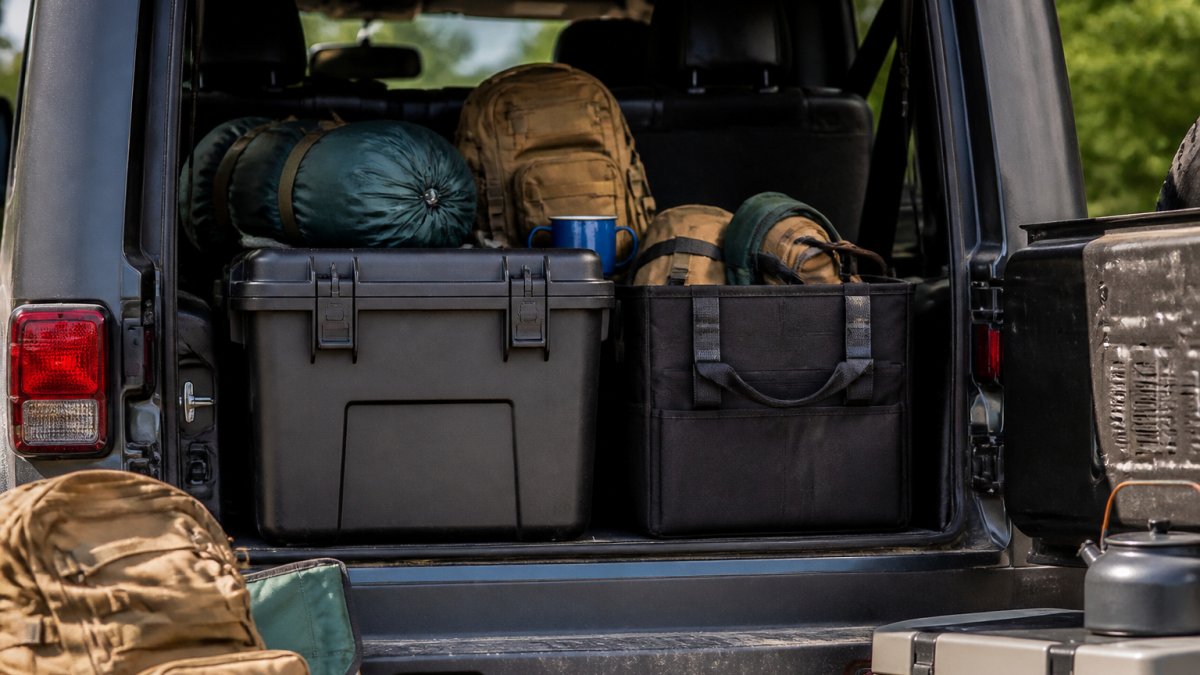
Small gear is where campsite chaos starts. Soft-sided bags and hanging organisers keep the little things visible, dry and off the ground, and they cost far less than another hard box.
For clothing and sleeping bags, a compression sack is the space-saving answer. It squeezes soft items down, freeing room in the vehicle for the gear that cannot compress.
Watch out: soft bags left on damp ground wick moisture into clothing overnight. Hang them or set them on a groundsheet, never directly on grass.
Space Saving Camping Hacks for Tight Vehicles and Trailers
Space saving camping hacks work best when you pack vertically and use the dead space nobody thinks about. Readers squeezing gear into tight vehicles can compare waterproof storage bags for camping that save and protect space. Three moves cover most tight-vehicle problems.
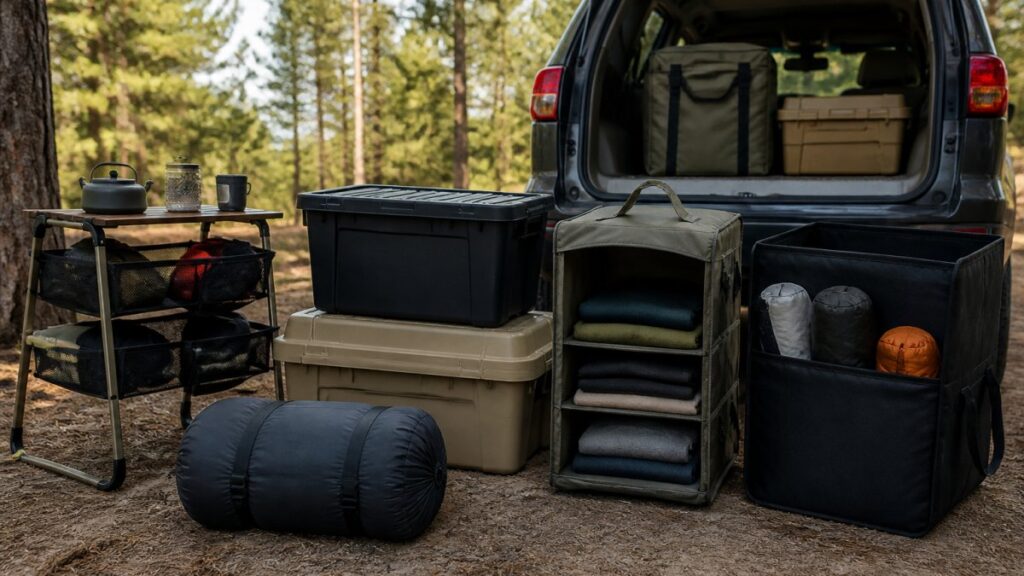
- Pack by zone, not by item. Assign one box to cooking, one to sleeping, one to tools. You stop unpacking the whole vehicle to find a torch.
- Use vertical space. Stacking trunks and hanging organisers free up floor area that flat packing wastes.
- Compress soft goods. Sleeping bags and clothing shrink dramatically in a compression sack, leaving room for bulkier equipment.
A common mistake is buying one giant tub and filling it. Big tubs become bottomless pits. Several smaller, labelled containers beat one large one every time.
How to Dry a Tent After Camping and Store It Without Mould
Mould is the most common way a good tent dies early. The fix is simple: dry the tent completely before storage, every single time, even if you have to pitch it in the backyard.
Follow these steps:
- Pitch or hang the tent in shade with good airflow
- Wipe down the fly and floor with a clean cloth
- Leave all doors and vents open until fully dry to the touch
- Check seams, corners and the stuff sack for damp
- Store loosely folded in a dry, ventilated space, never compressed tight for long periods
Watch out: packing a damp tent “just for the drive home” is how mildew starts. If you must pack wet, unpack and dry it within a day.
Store tents away from concrete floors that sweat and out of direct sun, which degrades coated fabrics over time.
Choosing Storage by Camping Style and Vehicle
Storage should follow your camping style and your vehicle, not the other way around.
Use the table below as a starting filter, then check the specific figures for any product before you buy.
| Camping style | Typical vehicle | Storage priority | Practical volume guide | Watch the weight |
|---|---|---|---|---|
| Weekend car camper | Sedan or SUV | Stackable trunks plus a hanging organiser | 60-120 L total across two or three containers | Keep each loaded box under about 15 kg so one person can lift it in and out |
| Caravan or motorhome | Towed or driven | Fixed shelves plus collapsible bins | 100-200 L, split into cupboard-sized modules | Fixed shelving should be anchored; loose bins should not exceed 10 kg loaded |
| Overlanding | Four-wheel-drive | Lockable, weather-resistant hard cases | 80-160 L, with one case reserved for recovery and tools | Heavy cases belong low and forward of the rear axle |
| Backpacking | On foot | Compression sacks and lightweight bags | 40-70 L total pack volume | Every gram counts; soft bags only |
A caravan owner benefits most from a portable shelf or cabinet that turns a cupboard into usable vertical storage. A four-wheel-drive tourer should prioritise dust and water resistance, because corrugated roads push fine dust into everything.
Capacity claims need a reality check. Nominal volume and usable volume are different. A 70 L box with thick walls, a lid recess and internal dividers may hold closer to 55 L of actual gear.
Plan for safe lifting. A loaded hard case can easily exceed 25 kg, which is awkward for one person to lift from a boot or roof rack.
A simple rule that works across every style: buy for the worst conditions your setup will actually meet, not the best. If your trips include corrugated roads or coastal humidity, pay for dust and water resistance now rather than replacing damp gear later.
Building a Packing System That Works on the Road
A packing system is a repeatable routine, not a one-off tidy-up. For the full walkthrough, read this step-by-step guide to packing camping gear efficiently. Build it once and every trip gets faster.
Step 1: Group by activity, not by item type. Create five groups: cooking and food, sleeping and clothing, lighting and power, tools and recovery, and personal and hygiene. Every item belongs to exactly one group. This stops the classic failure where the gas lighter ends up in the sleeping box because it was in someone’s pocket.
Step 2: Assign one container per group. A group should fit one container, or one container plus a small soft bag. If a group overflows, split it by frequency of use rather than buying a bigger box.
Step 3: Label every container on two faces. Use a permanent marker or a laminated label on the end and the lid. Two faces matter because containers get stacked and rotated; a label on the lid alone disappears when the box is under something else. Colour-coding by group is faster still: one colour per activity, visible at a glance.
Step 4: Pack in reverse order of use. The first things you need at camp should be the last things loaded and the first things out. In practice that means:
- Recovery gear, tools and spare parts at the very bottom or furthest forward.
- Sleeping boxes and clothing next.
- Cooking and food containers above them.
- The camp kitchen, chairs and lighting closest to the tailgate or door.
- The hanging organiser and small-item bag on top or hooked inside the door.
Step 5: Set up camp in zones. At the campsite, unpack to zones rather than piles.
Step 6: Run a five-minute pack-down check. Before leaving camp, walk the zones and confirm each container is closed, latched and accounted for. A missing container is obvious when every group has a home; a missing loose item is not.
The most common system failure is the “miscellaneous” box. Once a container has no defined group, it becomes a bottomless pit and the system collapses. If you genuinely need a miscellaneous container, keep it small and empty it after every trip.
The payoff is consistency. When every item has a home, you notice immediately when something is missing before you leave, not after you arrive.
Shop CampNation’s Camping Storage Range
CampNation offers a selected range of camping gear, with quick and reliable shipping. Shoppers can browse foldable camping storage shelves with hooks in the range. Check the website for what is currently available.
Storage is one of those purchases that quietly improves every trip after it. Get the system right once and packing stops being a chore.
Frequently Asked Questions
Are plastic storage tubs or fabric bags better for camping?
It depends on what you are storing and how you travel. Rigid plastic boxes such as the Plano Sportsman’s Trunk or Rubbermaid ActionPacker protect heavy or fragile gear and stack neatly in a vehicle boot or trailer. Fabric bags and hanging organisers suit soft items like clothing, sleeping bags and small tools, and they compress into gaps that a hard box cannot. Many campers run both: a sealed box for kitchen and dry goods, plus soft bags for bedding and personal gear. Match the container to the item, not the other way around.
What are the most durable camping storage solutions for off-road trips?
For corrugated tracks and dust, sealed cases outperform open tubs. Sealed hard cases generally offer better protection against dust and water than open tubs. If budget matters more than sealing, the Rubbermaid ActionPacker has a long record in vehicle-based camping. Whichever you pick, strap it down and avoid overfilling, because a lid that will not latch lets in dust.
How do I organise camping equipment for easy access in a vehicle?
Pack by frequency of use, not by category. Items you reach for every hour, such as water, snacks, sunscreen and a torch, go nearest the tailgate or side door. Kitchen gear sits in one clearly labelled box so you never unpack three crates to find a stove. Use the Nite Ize GearLine system to hang lanterns and utensils off the ground at camp, and keep a dedicated small-items pouch for pegs, guy lines and repair tape. A clear window or label on each container, like the RUX gear box, saves guesswork when you are tired.
What are the best space-saving storage hacks for small camper trailers?
Start with collapsible gear: walls that fold flat free up real space when the box is empty. Hang rather than stack, using a gear line under the awning for utensils and lights. Use vertical space inside the trailer with stackable crates that have moulded grooves, and keep bedding in compression bags rather than bulky tubs. Reserve one shallow tray for small essentials so they do not migrate to the bottom of a deep box. Measure your storage bay before buying anything, and check external dimensions rather than advertised volume.
How do I store camping gear at home to prevent mould?
Dry everything completely before it goes into storage, especially tents, swags and sleeping bags. A tent packed damp develops mildew within days, so air it fully, wipe down the floor, and store it loosely rather than compressed. Keep gear in a dry, ventilated space away from concrete floors that sweat. Leave hard cases slightly open in storage so air moves through, and avoid sealing damp items in plastic tubs. Check your gear once a season, and treat any musty smell as a sign to air and clean before the next trip.
Ready to sort your setup before the next adventure? At CampNation, we stock premium storage gear chosen to last, with quick and reliable shipping so it arrives in time. Browse the range, compare formats, and get started with CampNation to build a camp that packs easier every time.