Table of Contents
- Smart Camping Add-Ons for Comfort: What Actually Works
- Sleeping Systems: Toppers, Pillows and Stretcher Beds
- Best Portable Power Stations for Camping
- How to Keep a Tent Cool in Summer
- Camp Kitchen and Storage Solutions That Save Setup Time
- Ergonomic Setup for Aging Campers
- Eco-Friendly Comfort: Sustainable Camping Add-Ons
- Frequently Asked Questions
Last Updated: October 7, 2026
Smart Camping Add-Ons for Comfort: What Actually Works
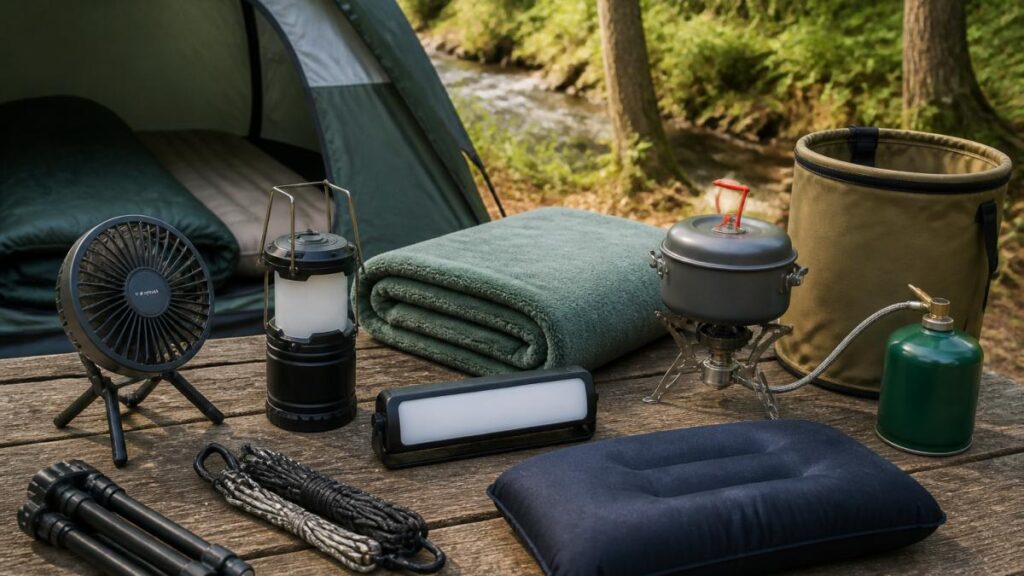
Most people buy a tent, a sleeping bag and an esky, then wonder why they still sleep badly. The gap is almost always in the add-ons. Below are seven upgrades that genuinely change how a night outdoors feels, from sleeping systems to power to ventilation.
Why ‘Smart’ Comfort Beats Just Buying More Gear
Buying more gear is the default response to an uncomfortable trip, and the wrong one.
A smarter approach is to identify the one or two failure points in your setup and fix those. Three cheap, well-chosen add-ons beat a fourth bulky item every time, and pack smaller too.
Gear that does one job well is also faster to pitch, pack and live with across a multi-day trip.
Sleeping Systems: Toppers, Pillows and Stretcher Beds
Sleep is where comfort is won or lost, and the fix usually costs less than a new swag. A self-inflating mattress topper, a memory foam pillow and a stretcher bed each solve a different problem, so match the add-on to the symptom.
If you wake up with a sore back, the issue is usually support, not softness. A stretcher bed lifts you off the ground entirely, helping with cold, uneven ground and with getting up in the morning.
Choosing a Topper for a Side Sleeper
A side sleeper needs a topper thick enough to stop shoulder pressure, generally 5cm or more, and firm enough that the hips do not sink through to the ground. Too soft and your spine bends; too thin and your shoulder takes the load. Check two things before buying: packed size, because a topper that will not fit in your bag will stay home, and the valve and inflation method, since one that takes ten minutes to inflate defeats the purpose.
Side sleepers get the most benefit from a topper paired with a pillow that has a height adjustment layer. If your shoulder feels numb in the morning, the pillow is usually too low, not the mattress too hard.
Best Portable Power Stations for Camping
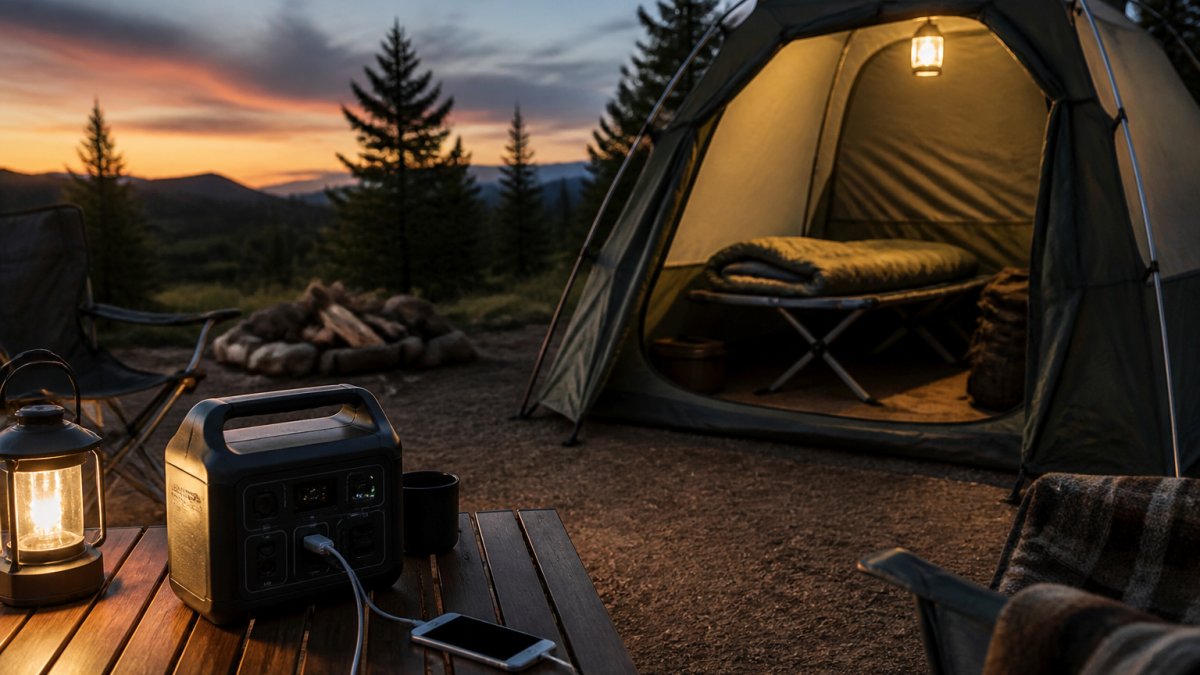
A portable power station is a battery bank large enough to run a fridge, charge phones and laptops, and power lighting without a generator. For car camping, overlanding and van life, it changes what a campsite can do.
Lithium-based units are now compact, quiet and safe to run inside a tent’s vestibule. The trade-off is weight and cost, both scaling with capacity.
The ‘Smart’ Layer Most Buyers Ignore
What separates a modern power station from a big battery is the connected layer: Bluetooth or Wi-Fi, a companion app, and updatable firmware. That matters in three practical ways:
- Remote monitoring. You can check state of charge from inside your sleeping bag instead of unzipping the tent at 11pm to squint at a display. Some apps log input and output over time, so you learn how much your fridge actually draws overnight rather than guessing.
- Scheduled and conditional output. Certain models let you set an AC or DC port to switch off at a set time, or to run only when solar input exceeds a threshold. That stops a fridge from draining the bank on a cloudy morning and preserves charge for lighting at night.
- Alerts and cut-offs. Low-battery push notifications and configurable shutdown thresholds protect both the battery and your food. A unit that warns you at 20 per cent is far more useful than one that simply dies.
Pass-through charging is also worth checking: it lets the station charge from a wall or solar panel while powering devices, keeping a fridge cold on a long drive without draining the car battery.
Matching Capacity to Your Trip Length
Match capacity to what you actually run, not the biggest number on the box. Add up your devices’ watt-hours, then buy roughly double that for a two-night trip to allow for cold weather and inefficiency.
| Trip Type | Typical Load | What to Prioritise |
|---|---|---|
| Overnight, tent | Phones, lamp, small fan | Compact size, USB-C output |
| Weekend, car camping | Fridge, lighting, devices | Mid capacity, fast recharge |
| Multi-day, van life | Fridge, laptop, shower pump | High capacity, solar input |
| Remote, off-grid | Everything above | Solar compatibility, durability |
Solar input matters more than most buyers expect. A panel that trickle-charges during the day keeps a fridge running indefinitely in good sun, which is why portable power and solar are usually bought together.
Before you buy, run your fridge on the station at home for 24 hours and note the watt-hours consumed in the app. That single number tells you more about required capacity than any spec sheet.
Never run a fuel-burning generator inside a tent or vestibule, and never chain power stations to extend runtime unless the manufacturer explicitly supports it. Carbon monoxide and incompatible inverter outputs are both genuine hazards.
How to Keep a Tent Cool in Summer
Keeping a tent cool in summer comes down to shade, airflow and ground insulation. Get all three right and the inside temperature stays close to the outside air; miss one and the tent becomes a greenhouse by mid-morning.
Shade is the biggest lever: pitch under trees or use a fly or tarp over the tent, because direct sun on the fabric drives the heat. Airflow comes next, open vents at both ends so air moves through rather than sitting still.
Ventilation, Shade and Ground Insulation
Ventilation works best as cross-flow: air enters low on one side and exits high on the other. Many tents have a low rear vent and a high front door, exactly the setup you want.
Mosquito nets are not the enemy of airflow. A fine mesh door left open moves far more air than a closed solid door and keeps insects out. Pair a mesh inner with a fly that rolls back, and you get a tent that breathes in the heat and closes up when the weather turns.
Never run a fuel-burning heater or generator inside a tent or its vestibule, even with vents open. Carbon monoxide builds fast in enclosed fabric spaces. Use battery-powered lighting and heating only.
Camp Kitchen and Storage Solutions That Save Setup Time
Setup time is the quiet killer of a good camping trip. The fix is not fewer items, but items that live in a fixed place and come out ready to use.
A camp kitchen that folds into its own case, with a spot for the stove, utensils and gas, cuts unpacking to a single movement.
Keep dry goods in sealed boxes and cooking gear in a case that closes. In dusty conditions, an open crate of utensils is a cleaning job waiting to happen.
The best storage add-on is the one that stays packed between trips. If you unpack and repack the same crate every time, you have already solved half your setup problem.
Ergonomic Setup for Aging Campers
Comfort matters more, not less, as the body gets less forgiving, and the fixes are simple and cheap.
Getting off the ground is the first fix: a stretcher bed or raised camp cot removes the hardest part of the day, standing up in the morning. Keep frequently used items at waist height rather than in a box on the ground, and use a headlamp instead of a torch so both hands stay free.
Lighting is an ergonomic tool too. A warm, bright camp light at head height reduces the squinting and stumbling that cause most late-night trips to the toilet block.
Eco-Friendly Comfort: Sustainable Camping Add-Ons
Sustainable comfort is not about going without. It is about choosing add-ons that last, are safe to sleep on, and leave the site as you found it, the angle most gear lists skip, and where the smartest comfort upgrades now sit.
Materials That Matter for Sleep Comfort
If you spend eight hours a night with your face against a pillow and your skin against a topper, the material is a comfort issue, not just an ethical one. Three things are worth checking on any bedding add-on:
- Certifications. Look for OEKO-TEX Standard 100 on textiles, which indicates the finished article has been tested for harmful substances (OEKO-TEX® STANDARD 100). For foam, CertiPUR or equivalent foam certifications indicate the foam has been screened for certain restricted substances and measured for emissions. These are voluntary schemes, so absence is not proof of harm, but presence is a useful filter.
- Fill and cover materials. Natural latex and wool-based fills tend to regulate temperature and moisture better than cheap synthetic foams, which is a genuine comfort benefit in humid conditions. Wool in particular moves moisture away from the body, which is why it works in both cool and warm weather.
- Repairability. A topper with a removable, washable cover will outlast one with a sealed cover, because you can clean it rather than replace it. Zips and replacement covers are the difference between a three-season item and a one-season item.
Power and Lighting Without Disposables
Rechargeable lighting and solar charging replace disposable batteries and reduce what you carry out. The practical upgrade is a light with a built-in lithium cell and USB-C charging, paired with a small folding solar panel that can also top up a power station.
Motion-sensing and timer functions are not gimmicks here. A light that switches off when nobody is moving draws less from the battery, meaning fewer charge cycles and a longer service life before the cell degrades, sustainability as product longevity rather than marketing.
Hygiene and Water
A camp shower with a refillable tank, rather than single-use wipes, handles hygiene with less packaging. Look for a replaceable pump and a tank that can be repaired rather than discarded. Biodegradable soaps are worth choosing, but only use them well away from waterways, even ‘natural’ soaps affect aquatic life.
The Over-Buying Problem
The least sustainable add-on is the one you buy, use twice, and leave in the garage. A simple gear checklist, reused every trip, stops the over-buying that fills garages with things nobody uses. Before adding anything, ask whether it replaces two items you already carry or fixes a specific failure point. If it does neither, it is weight and waste.
Durable, repairable, certified gear beats cheap gear replaced every season, for the wallet, for comfort, and for waste. The greenest comfort upgrade is usually the one you keep for a decade.
Frequently Asked Questions
What are the best camping add-ons for a better night’s sleep?
Start with a self-inflating mattress or memory foam topper to add ground insulation and cushioning, then add a memory foam pillow suited to your sleeping position. A stretcher bed lifts you off cold ground, which matters more than most people expect. Finish with a compact camp light that has a warm, dim setting so you can read without disrupting sleep. Together these address thermal insulation, support and lighting, the three factors that most affect restful sleep outdoors.
Are portable power stations worth it for camping comfort?
For trips longer than a weekend, yes. A portable power station keeps phones, camp lights, fans and small appliances running without hunting for powered sites. Match capacity to your usage: a small unit suits charging devices and lights, while larger units run a portable fridge or CPAP machine. Check the output wattage against what you plan to plug in, and confirm it supports solar input if you camp off-grid.
What are the best ways to keep a tent cool in summer?
Pitch in shade and orient the tent so prevailing breezes pass through. Open both the door and rear vent to create cross-flow, and use a reflective fly or extra shade cloth over the tent body. A 12V fan powered by a portable power station moves air inside when there is no breeze. Ground insulation matters too: a reflective mat under the tent reduces heat radiating up through the floor, which keeps the interior noticeably cooler.
What are some must-have camping upgrades for beginners?
Prioritise a comfortable sleeping setup, a reliable camp light and a simple storage system like a gear checklist and stackable crates. A compact camp table and a two-burner stove make cooking easier and safer. Add a camp shower or basic hygiene kit for multi-day trips, and a portable power station if you want to charge devices. Buy durable, high-quality items once rather than replacing budget gear every season, and test everything at home before your first trip.