Table of Contents
- Portable Power Stations for Van Life: What Actually Matters
- Quick Comparison: Portable Power Stations for Van Life
- The Picks: Five Portable Power Stations Reviewed
- Van Life Power Station Capacity: Sizing It Right
- Portable Power Station vs Leisure Battery: Which Fits Your Van?
- Choosing a Portable Power Station for a 12V Fridge
- How to Charge a Power Station in a Van
- Verdict: Which Portable Power Station Should You Buy?
- Frequently Asked Questions
Last Updated: October 18, 2026
Portable Power Stations for Van Life: What Actually Matters
A portable power station is a battery-powered box that stores energy and delivers it through standard AC, USB and 12V outlets, letting you run a fridge, charge a laptop or boil a kettle without wiring into the vehicle. For van life, three things matter: usable capacity in watt-hours, continuous inverter output, and how fast you can refill while driving.
Below, we break down portable power stations worth considering for van life, then show how to size one and how they compare with a leisure battery.
The single most useful number on any power station spec sheet is watt-hours, not watts. Watts tell you what it can run right now. Watt-hours tell you how long it can run it.
Quick Comparison: Portable Power Stations for Van Life
Here is how some picks stack up on the criteria that matter most in a van. Where a manufacturer has not published an Australian price or full specification, we say so rather than guess.
| Model | Best For | Battery Chemistry | Key Strength | Australian Price |
|---|---|---|---|---|
| CampNation range | Curated, van-ready gear | Varies by model | Selected for durability and support | Check current pricing on site |
| BLUETTI EB3A | Compact cycle-life pick | Not confirmed in source | Long cycle life, campervan-focused | Not verified |
| Anker SOLIX F3000 | Best overall all-rounder | Not confirmed in source | Best-overall designation in roundup | Not verified |
| EcoFlow DELTA Pro | Expandable fast charging | Not confirmed in source | Expandable battery, fast recharge | Not verified |
| Jackery Explorer 300 | Grab-and-go value | Not confirmed in source | Light, portable, value positioning | US$280 quoted in source, AUD not verified |
A word of caution: several of these models are sold in Australia through different channels and configurations, and specs vary by region. Always check the Australian spec sheet for the exact unit, particularly the inverter’s continuous and surge ratings.
The Picks: Five Portable Power Stations Reviewed
Each pick is here for a different reason. None suits every van.
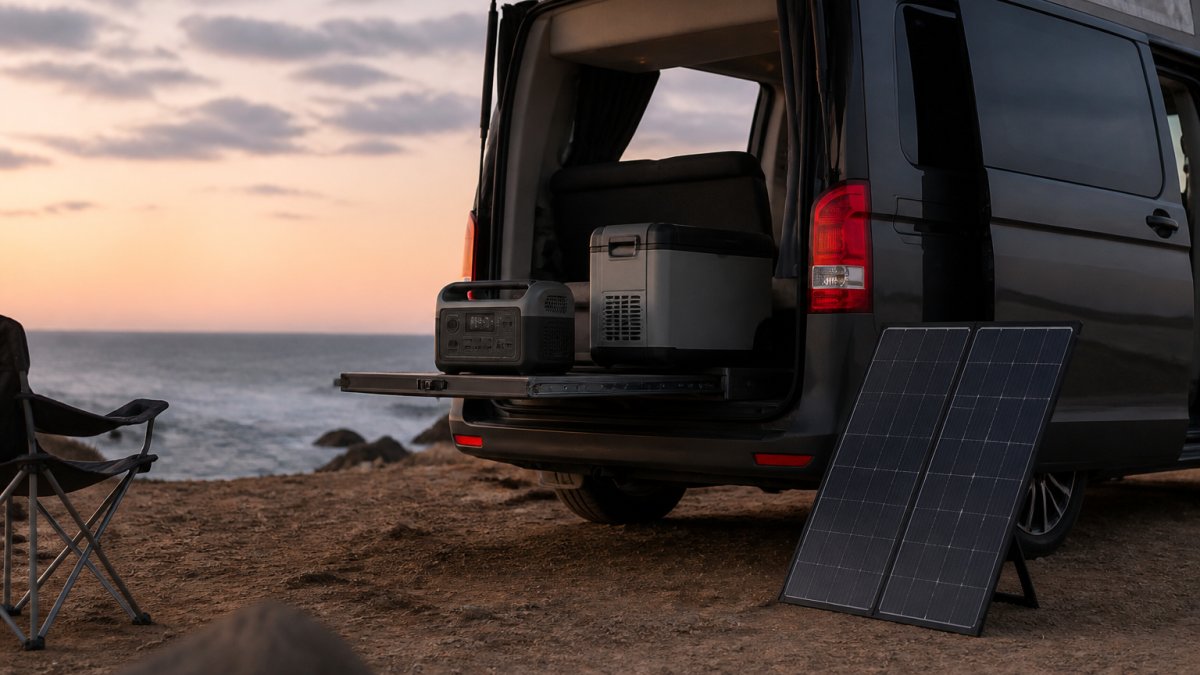
CampNation: The Curated Van Power Range
Our own range is the one we know best, and we position it first because we stand behind what we stock.
Tell us your fridge draw, charging setup and how many nights you plan to be off-grid, and we can point you at a unit that fits rather than one that merely looks impressive on paper.
The honest limitation: we are a curated retailer, not a manufacturer, so battery chemistry and capacity vary by model.
BLUETTI EB3A: The Compact Cycle-Life Pick
Practical Motorhome named the EB3A as its pick for campervan use and reported a lifespan of up to 4,000 charge cycles.
For a van in near-constant use, cycling the battery most days, that matters more than slightly larger capacity. The EB3A is compact, so treat it as a fridge-and-devices station rather than something that runs a kettle and hair dryer at once.
What the sources we reviewed do not give us is verified Australian pricing or a full local specification sheet. Confirm both before you commit.
Anker SOLIX F3000: The Best-Overall All-Rounder
Outside’s camping and van-life roundup gave the SOLIX F3000 its best-overall designation, a meaningful signal because that publication tests across many use cases rather than optimising for one.
The trade-off with any large all-rounder is weight and footprint. A unit in this class takes up real floor or bench space, so plan where it lives before you buy, and secure it so it cannot slide under braking.
As with the BLUETTI, the sources we reviewed do not confirm Australian pricing or the exact local specification. Check the Australian listing.
EcoFlow DELTA Pro: The Expandable Fast-Charging Option
A van-life guide we reviewed describes the DELTA Pro as having large capacity, fast charging and an expandable battery system.
Fast charging changes the maths on your daily driving. If the unit refills quickly from a vehicle’s 12V system or campsite mains, you can run a smaller battery than you otherwise would, because you top it up more often.
The catch is that expandable systems invite scope creep. It is easy to add capacity you never actually use. Work out your real daily consumption first, then size the system to it.
Jackery Explorer 300: The Grab-and-Go Value Pick
GearJunkie describes the Explorer 300 as a value pick and a grab-and-go battery.
For weekend van users who need to charge devices, run a small fridge and light the interior, a compact unit like this covers the basics without the weight or cost of a large system.
One note on pricing: the source quotes US$280, which is not an Australian price. Do not convert it and treat the result as local pricing, because import costs, GST and distributor margins all change the number.
Van Life Power Station Capacity: Sizing It Right
Capacity is where most van buyers get it wrong, in both directions. The fix is a simple daily energy budget in watt-hours.
Watt-hours (Wh) is the total energy a battery can store. To estimate your daily need, multiply each appliance’s wattage by the hours per day you use it, then add the results.
| Appliance | Typical Draw | Hours/Day | Daily Wh |
|---|---|---|---|
| 12V compressor fridge | 45W (cycling) | 8 effective | 360 |
| Laptop charging | 60W | 2 | 120 |
| LED interior lights | 10W | 4 | 40 |
| Phone and camera charging | 30W | 2 | 60 |
| Small fan | 15W | 3 | 45 |
| Total | 625 |
That total is the number to size against. A 600Wh station would be flat by morning on this budget; a 1,000Wh unit leaves headroom.
Run your fridge budget on its cycling draw, not its rated peak. A compressor fridge runs intermittently, so the honest figure is the average over a day, not the label wattage multiplied by 24.
Portable Power Station vs Leisure Battery: Which Fits Your Van?
The short answer: a leisure battery wins for a permanent, high-capacity installation, and a portable power station wins for flexibility and simplicity. Many well-sorted vans end up with both.
A leisure battery is a deep-cycle battery, usually mounted permanently and wired into the van’s charging system, that runs the fridge, lights and accessories.
A portable power station is a self-contained battery and inverter in a case with its own outlets.
| Factor | Leisure Battery | Portable Power Station |
|---|---|---|
| Installation | Requires wiring and fusing | Plug and play |
| Portability | Fixed in vehicle | Carry anywhere |
| Expansion | Add batteries to the bank | Add units or expansion batteries |
| Best for | Full-time builds | Weekend use, flexible setups |
| Charging | Vehicle alternator, solar, mains | Mains, solar, vehicle socket |
If you are building out a van for full-time living, a properly installed leisure battery with solar is usually the better long-term investment.
Choosing a Portable Power Station for a 12V Fridge
A 12V fridge decides most van power setups, and it is the one that trips people up. The critical number is not the running draw but the startup surge.
Compressor motors draw a brief spike of current when they start, often several times their running draw.
Second, match the connection. Many 12V fridges run happily from a power station’s 12V DC outlet, avoiding the inverter entirely and saving energy.
Third, think about duty cycle. A fridge in a hot van runs more often than the same fridge in a cool one.
Running a fridge through the AC outlet instead of the 12V DC outlet wastes energy at every conversion and drains your battery faster. Use the DC outlet where the fridge supports it.
How to Charge a Power Station in a Van
Charging while driving is the biggest advantage of a van setup, and the most misunderstood. Here is how the options compare.
- Vehicle 12V socket: The simplest option. Plug into the van’s cigarette or accessory socket and charge as you drive. Output is limited by the socket’s fuse rating, so expect slow charging. Check that the socket stays live with the ignition off, or you may drain the starter battery.
- Mains power: The fastest option when you have access to a powered site or a home base. A full recharge from mains before a trip gives you a full battery to start with.
- Solar panels: The off-grid option. Match the panel’s wattage to the station’s input limits, and remember that real-world solar output is well below the panel’s rated figure on cloudy days or when the panel is not angled at the sun.
- Alternator charging via a DC-to-DC charger: The most efficient way to charge a large battery bank while driving. This is a proper installation job and should be done with correct fusing and cable sizing.
For a portable station, the vehicle socket and solar are the realistic on-the-road options. For a permanent leisure battery, a DC-to-DC charger is the setup to aim for.
Test your charging setup on a real trip before you rely on it. Drive a full day with the fridge running and the station charging, then check the state of charge at the end. That tells you more than any spec sheet.
Verdict: Which Portable Power Station Should You Buy?
If cycle life is your priority, the BLUETTI EB3A’s reported 4,000-cycle lifespan is worth a close look. For an all-rounder with independent testing behind it, the Anker SOLIX F3000 carries a best-overall designation.
Whatever you choose, check the Australian price and specification directly before buying. Several models above are sold in different configurations by region, and the local spec sheet is the only one that counts.
Frequently Asked Questions
How big of a portable power station do I need for van life?
Work backwards from your daily load. A typical van setup runs a 12V fridge (about 0.5-0.8 kWh per day), LED lights, phone and laptop charging, and occasional small appliances. Add those up, then size for one to two days of autonomy so cloudy weather does not leave you flat. For most couples touring with a fridge, a unit in the 1-2 kWh range is the practical starting point, with expandable models giving room to grow. CampNation’s range is worth checking for current capacity options.
Can a portable power station run a 12V fridge?
Yes. A portable power station for a 12V fridge needs enough watt-hours to cover the fridge’s daily draw, and enough continuous output to handle start-up surge. Fridges cycle on and off, so a unit with 500-1000 Wh will typically run a small compressor fridge for a day or more depending on ambient temperature and how often the lid is opened. In hot weather, consumption rises, so budget extra capacity and use solar charging to top up during the day.
How do you charge a portable power station while driving?
Most units accept a 12V car lead, which charges from the vehicle’s accessory socket while the engine runs. Charging speeds vary: some models pull 100W or more from the vehicle, others are limited to around 60-100W. A DC-to-DC charger wired to the starter battery is a faster, more reliable option for full-time van life. Ensure the vehicle’s alternator and wiring can handle the load, and never charge from a socket that is dead when the ignition is off.
What is the difference between a portable power station and a leisure battery?
A portable power station is a sealed, plug-and-play unit combining a lithium battery, inverter, outlets and charging electronics in one case. A leisure battery is a standalone battery that needs separate wiring, an inverter, fuses and a charging system to work. Power stations suit renters, weekenders and anyone who wants to move power between vehicles. Leisure batteries suit permanent installs where you want larger capacity and custom wiring. Both have a place, and some van owners run both.
How long does a portable power station last?
Lifespan depends on battery chemistry and cycle count. LiFePO4 units commonly rate 2,000-4,000 cycles before capacity drops to around 80%, which is roughly 6-10 years of daily use. The BLUETTI EB3A, for example, is cited at up to 4,000 life cycles. Store the unit at moderate charge, avoid leaving it fully depleted, and keep it out of extreme heat to get the most from it. Warranty terms and repairability vary by brand, so check both before buying.
Fitting out a van with the right power setup takes a bit of arithmetic and a lot of honesty about how you actually camp. CampNation stocks a curated range of gear selected for durability and real-world performance, with quick and reliable shipping so your setup is ready before your trip is. Browse the CampNation power range, tell us your fridge draw and charging plans, and we will help you match a station to the way you travel.