Table of Contents
- Self-Inflating Mat vs Air Mattress: Key Differences at a Glance
- Comfort and Sleeping Support
- Best Sleeping Mat for Camping: Warmth and Insulation
- Camping Mattress Warmth and R-Value: Cold-Weather Performance
- Air Mattress Disadvantages for Camping You Should Know
- Camping Mattress Pack Size and Weight: Portability Matters
- Durability, Reliability, and Long-Term Care
- Which Option Suits Your Camping Style?
- Frequently Asked Questions
Last Updated: October 10, 2026
Self-Inflating Mat vs Air Mattress: Key Differences at a Glance
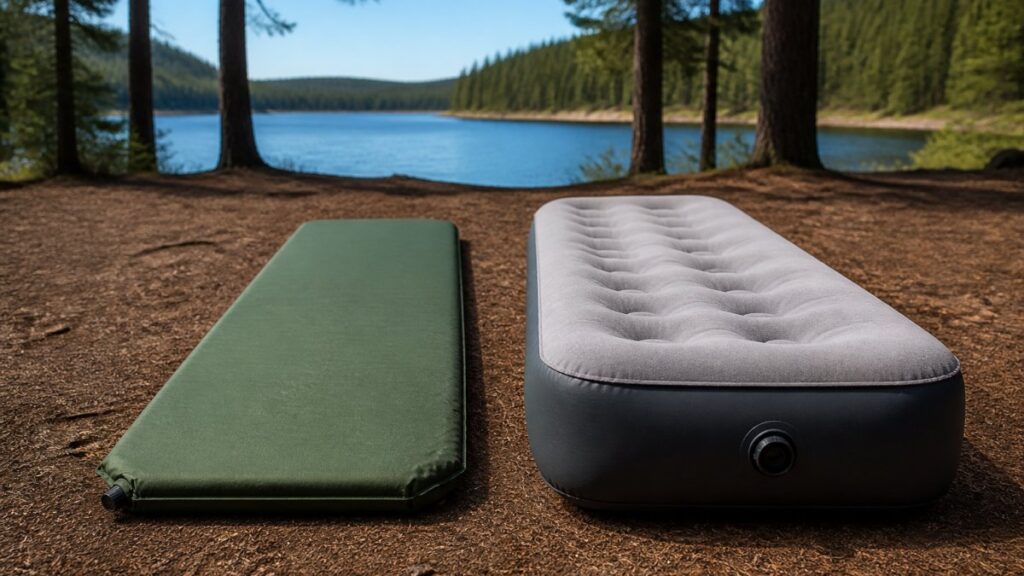
Choosing between a self-inflating mat vs air mattress means deciding between two fundamentally different approaches to comfort. A self-inflating mat combines a foam core with a valve that draws in air when opened; an air mattress relies entirely on pressurised air. The choice depends on your camping style, weight tolerance, and expected conditions.
| Feature | Self-Inflating Mat | Air Mattress |
|---|---|---|
| Setup time | 2-5 minutes | 5-15 minutes |
| Packed weight | 1-2 kg | 0.5-1.5 kg |
| Insulation (R-value) | 2-5 | 0-2 |
| Puncture risk | Low | High |
| Comfort feel | Firm, supportive | Soft, bouncy |
| Cold-weather performance | Good | Poor |
| Repair difficulty | Easy | Difficult |
| Price range | Mid-range | Budget to premium |
The core trade-off: air mattresses feel bed-like but collapse if punctured and offer minimal insulation. Self-inflating mats sacrifice softness for durability, warmth, and reliability.
Comfort and Sleeping Support
An air mattress wins on immediate comfort, soft, responsive, and bed-like. Your body sinks slightly into the surface, which many sleepers find intuitive.
A self-inflating mat feels firmer due to its foam core. Thickness varies: thinner mats (25mm) feel closer to ground, while thicker ones (50mm+) approach air mattress softness, though this affects packed size.
Comfort depends on terrain. A self-inflating mat’s foam flexes to accommodate lumps; an air mattress creates pressure points on uneven ground. On rough terrain, self-inflating mats perform better despite feeling firmer.
Side sleepers and heavier people often prefer air mattress cushioning; back sleepers prefer self-inflating mat support. Test both if possible, sleeping preference is personal.
Best Sleeping Mat for Camping: Warmth and Insulation
This is where the self-inflating mat vs air mattress decision becomes critical in cold conditions.
Ground temperature can be 10-15 degrees colder than air temperature. An air mattress offers almost zero insulation; air conducts cold efficiently, and body heat escapes downward. In winter or high-altitude camping, this leaves you shivering despite a warm sleeping bag.
A self-inflating mat’s foam core traps air in tiny pockets, creating genuine insulation measured as R-value. Self-inflating mats rate R2-R5, meaningfully reducing heat loss; air mattresses rate R0-R2.
For three-season camping, this gap matters less. For winter or high-altitude camping, it’s the difference between comfort and misery.
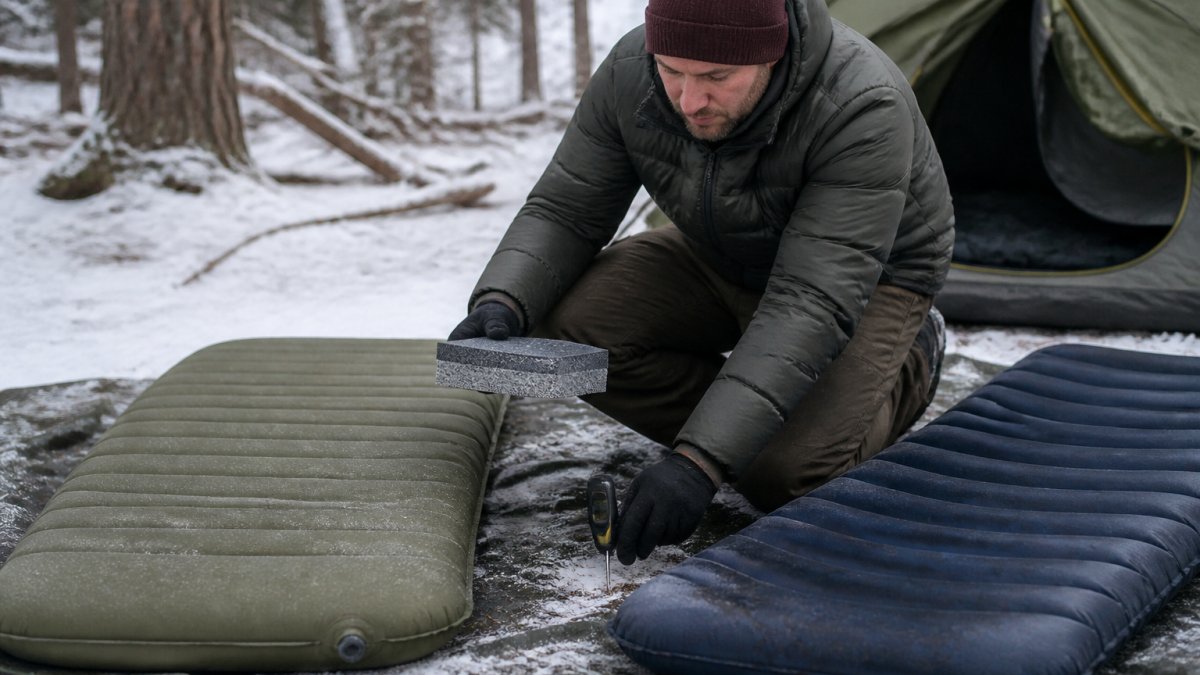
Camping Mattress Warmth and R-Value: Cold-Weather Performance
R-value quantifies insulation: R1-R2 provides minimal protection, R3-R5 handles most scenarios, R5+ is for winter or alpine use.
Most self-inflating mats rate R2-R5 depending on thickness and foam quality; some premium options reach R6. Air mattresses rarely exceed R2 because their design relies on air rather than foam.
Practical example: ground temperature 5°C, air temperature 10°C. With an air mattress, that 5-degree difference transfers to you. With a self-inflating mat rated R3, the difference is reduced by roughly 60%, so you experience closer to 8°C. That’s the difference between comfortable and cold.
Thickness and foam density both affect R-value. A 50mm mat with high-density foam outperforms a 75mm mat with low-density foam. Check R-value specifications; for winter camping, seek R4 or higher.
Air Mattress Disadvantages for Camping You Should Know
Puncture risk and repair difficulty. A single thorn or sharp rock can puncture an air mattress, causing complete collapse. Self-inflating mats are nearly puncture-proof; the foam core handles most contact. Field repairs of air mattresses are unreliable, they require 24 hours of curing time and careful application. A punctured air mattress often means sleeping on the ground. Self-inflating mats can be patched with foam-compatible adhesive and used within hours; small punctures don’t cause total collapse.
Valve failures and slow leaks. Air mattresses develop slow leaks from valve wear and seam stress. By year three, many lose 5-10 cm of height overnight. The valve is the weakest point; repeated opening, temperature cycling, and mineral deposits degrade the seal. Self-inflating mats have one valve and no seams under pressure, so they last longer.
Inflation dependency. Most air mattresses require a pump, manual, battery-powered, or foot pump. Forget the pump and you’re inflating by mouth, which exhausts you before you’re done and leaves you lightheaded. Self-inflating mats require no pump; you open the valve and they expand on their own over 2-5 minutes. This matters more than it sounds: a dead battery or forgotten pump on a multi-day trip is a genuine problem.
Cold-weather performance. An air mattress becomes genuinely uncomfortable in cold conditions. Ground temperature can be 10-15 degrees colder than air temperature, and an air mattress offers almost zero insulation, air conducts cold efficiently, and your body heat escapes downward. In winter or high-altitude camping, sleeping on an air mattress can leave you shivering despite a warm sleeping bag.
Noise and movement. Air mattresses make rustling and creaking sounds when you move, which some people find distracting. For couples sharing a tent, one person’s movement can wake the other. Self-inflating mats are silent.
Durability and cost-per-use. An air mattress typically lasts 2-4 years with regular use. If you camp 20 times per year, that’s 40-80 nights before replacement. A self-inflating mat lasts 5-10 years under the same use, meaning 100-200 nights. The upfront cost of a self-inflating mat is higher, but cost-per-night over five years typically favours self-inflating mats.
The honest assessment: air mattresses work well for warm-weather car camping where weight doesn’t matter, you’re staying close to your vehicle, and you’re not dealing with cold nights. They’re less practical for backpacking, winter camping, or remote trips where reliability and insulation matter.
Camping Mattress Pack Size and Weight: Portability Matters
Packed size and weight are where air mattresses pull ahead on paper, but the full picture is more nuanced.
Raw specifications. A quality air mattress weighs 0.5-1.5 kg and packs down to roughly the size of a sleeping bag when deflated. A self-inflating mat typically weighs 1-2 kg and is bulkier when rolled. For car camping or caravanning, this difference is irrelevant. You’re not carrying it far. For backpacking or long-distance trekking, weight and bulk add up.
The pump factor. Packed size isn’t the full story. A self-inflating mat stays rolled and compact. An air mattress needs a pump, which adds weight and bulk. Most people don’t factor pump weight into their calculations, but it’s real:
- A battery-powered pump adds 300-500 g and requires batteries
- A foot pump adds 200-300 g but requires physical effort and time
- A manual hand pump adds 100-150 g but is slow and tiring
If you’re carrying an air mattress, you’re also carrying one of these. The total system weight is often 1-2 kg, not the 0.5-1.5 kg advertised for the mattress alone. A self-inflating mat needs no pump, so the comparison becomes closer than it first appears.
Inflation and deflation time. Setup speed affects portability in practice. A self-inflating mat takes 2-5 minutes to fully inflate, you open the valve and wait. An air mattress with a battery pump takes 5-10 minutes. An air mattress with a foot pump takes 10-15 minutes of active pumping. At the end of a long hiking day, that time difference matters.
Bulk versus weight trade-off. A self-inflating mat is heavier but more compact in some dimensions. When packed, a 50 mm self-inflating mat might be 20 cm in diameter and 60 cm long, while an air mattress might be 15 cm in diameter and 80 cm long. In a backpack, the mat’s width matters more than its weight.
When weight matters most. If you’re hiking more than 10 km to your campsite, every 500 g matters. If you’re doing a multi-day trek with 15+ km daily, the cumulative weight of a heavier mat becomes fatiguing. If you’re hiking at altitude or in rough terrain, lighter gear reduces physical strain.
When bulk matters most. If you’re backpacking with a small pack (40-50 litres), bulk is the constraint. A self-inflating mat’s compact roll fits easily; an air mattress’s longer profile might force you to strap it externally, which is awkward. If you’re camping in tight spaces, a small tent, a van, or a canoe, the mat’s compactness is valuable.
The practical framework. Choose based on your actual trip style, not on theoretical portability. For car camping or caravanning, weight is irrelevant; durability and warmth become the decision factors. For backpacking under 10 km, a self-inflating mat’s reliability and insulation outweigh the weight penalty.
Durability, Reliability, and Long-Term Care
A self-inflating mat, treated reasonably, lasts 5-10 years or more. The foam doesn’t degrade quickly, and there’s only one valve to maintain. Repairs are simple: a small puncture gets patched with a foam-compatible adhesive and patch kit, and the mat continues working.
An air mattress typically lasts 2-4 years with regular use. Seams weaken, valves develop slow leaks, and the material degrades from UV exposure and temperature cycling. Repairs are harder: patching an air mattress requires waterproof adhesive and careful technique, and the patch often fails under pressure.
Long-term reliability favours self-inflating mats. If you camp regularly, you’ll replace an air mattress multiple times before a self-inflating mat needs retirement. The cost-per-use over five years typically favours self-inflating mats, despite higher initial cost.
Maintenance is straightforward for both. Dry them completely before storage to prevent mould. Store in a cool place away from direct sunlight. For self-inflating mats, leave the valve slightly open during storage so the foam doesn’t compress permanently. For air mattresses, store partially deflated to reduce valve stress.
Which Option Suits Your Camping Style?
Your camping context should drive the decision. A weekend camper doing car-based trips in summer? An air mattress works fine. You’re close to your vehicle, weight doesn’t matter, and you’re not dealing with cold nights. The softer feel might actually improve sleep.
A backpacker doing multi-day treks? A self-inflating mat is the practical choice. Weight matters, durability matters, and you need reliable gear that won’t fail mid-trip. The insulation also protects you if weather turns colder than expected.
A van-lifer or caravan traveller? Consider your climate. If you’re mostly in warm regions, an air mattress offers comfort. If you travel year-round or to mountains, a self-inflating mat provides better insulation and reliability for extended use.
A winter camper or alpine hiker? Self-inflating mat, no question. The R-value difference is non-negotiable.
The honest framework: prioritise weight and durability if you’re carrying your gear. Prioritise comfort and ease if you’re staying close to your vehicle. Prioritise insulation if you camp in cold conditions. Most people need to weight multiple factors, there’s rarely a perfect answer, only the best fit for your situation.
Frequently Asked Questions
Which is better for camping: a self-inflating mat or an air mattress?
It depends on your priorities. Self-inflating mats offer better insulation and are more reliable for cold weather and remote trips, making them ideal for serious campers. Air mattresses provide superior comfort and height but require more setup effort and are prone to punctures. Weekend campers often prefer air mattresses for comfort, while backcountry adventurers typically choose self-inflating mats for durability and warmth.
Is a self-inflating mat warmer than an air mattress?
Yes. Self-inflating mats contain bonded foam that traps body heat and provides insulation from cold ground. Air mattresses offer minimal insulation because air conducts temperature poorly. If you camp in cold conditions or sleep on damp ground, a self-inflating mat with a higher R-value will keep you significantly warmer and more comfortable throughout the night.
What are the main disadvantages of using an air bed for camping?
Air mattresses are vulnerable to punctures from sharp objects, tent stakes, or rough ground. They require a pump or significant lung effort to inflate, take up considerable packed space, and conduct ground cold directly into your sleeping bag. They also fail if the valve leaks overnight, leaving you sleeping on hard ground. Air beds are best suited to car camping or established campsites, not wilderness trips.
Do self-inflating mats need to be inflated?
Self-inflating mats partially inflate themselves when you open the valve, thanks to internal foam expansion. However, you’ll typically need to add a few breaths of air to reach full firmness and optimal comfort. This takes only 30 seconds to a minute, making setup quick and easy compared to fully manual air mattresses that require a pump or extended lung inflation.
Choosing the right sleeping setup transforms your camping experience from uncomfortable to genuinely restful. At CampNation, we stock both self-inflating mats and air mattresses from brands built for real outdoor conditions. Our team can help you match the right mat to your camping style, budget, and climate. Browse our sleeping system options and find the mat that lets you sleep confidently, whatever the season.